
Description
Performance Highlights
- Robust performance on low-template, degraded, or inhibitor-rich samples
- High allele recovery even in the presence of common inhibitors (e.g., hematin, humic acid)
- Stable and balanced profiles across a wide DNA input range (0.1–2 ng)
- Effective handling of overloaded DNA without profile distortion
- Choice of size standards: 450 (high fluorescence) or 24plex (standard)
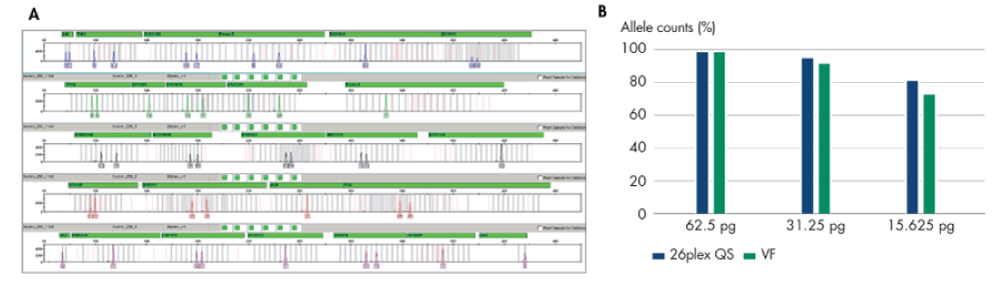
Figure 4. A Electropherogram of control DNA 9948. The sample was amplified in the presence of 250 ng/μl humic acid. Humic acid did not interfere with amplification, and a high-quality profile was obtained. The Quality Sensor fragments QS1 (lowest panel on the left) and QS2 (lowest panel on the right) were not adversely affected, indicating a successful run. B Comparison study. Sensitivity of the Investigator 26plex QS Kit was compared to VeriFiler® Plus (VP) in the presence of low amounts of DNA. The Investigator 26plex QS Kit outperforms other methods based on STR allele recovery rates. PCR was performed under standard handbook conditions
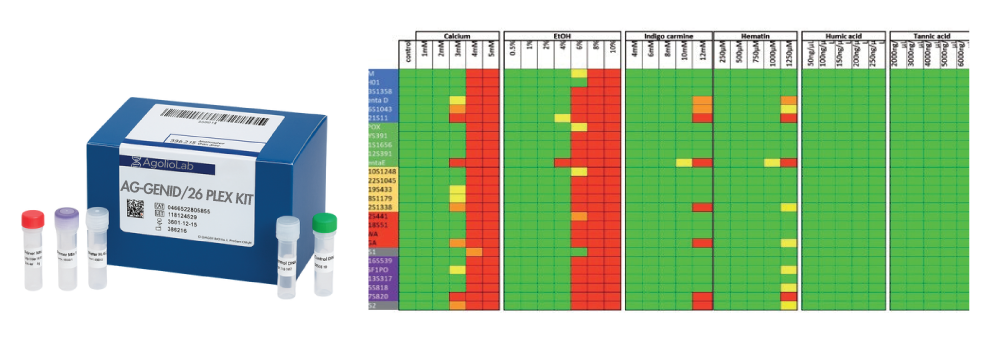
Figure 5. Ag-GenID/26 plex QS Kit inhibitor tolerance. The assay was tested with 6 inhibitors (calcium, ethanol, indigo carmine, hematin, humic acid and tannic acid). Control DNA sample of
500 pg was used and PCR was performed under standard handbook conditions. 50 RFU was used as the threshold for allele calling. Green: Consistently full profile. Yellow: 75% of expected PCR products detected. Orange: 50% of expected PCR products detected. Red: Less than 50% of expected PCR products detected.