
Description
Setting the Bar in Automated Liquid Handling Excellence
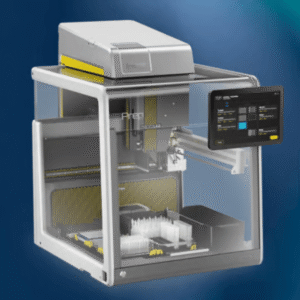
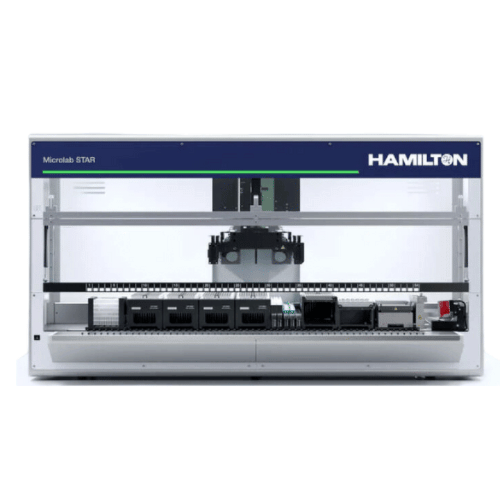
With thousands of installations in diverse laboratories across the globe, the Hamilton Microlab STAR Line is renowned for its engineering excellence and unlimited application potential.
Creating Value in Any Workflow
From simple nucleic acid extraction to complex cell-based assays requiring multiple on-deck devices, the Microlab STAR enhances efficiency and precision. The highly flexible design, along with a wide range of modules, carriers, and integrations, provide freedom to scale, change, and fully customize an automated solution to encompass workflow needs today and well into the future.
Smart Liquid Handling Starts Here
Compressed O-Ring Expansion II (CO-RE II) Technology creates a tight fit between the pipette channels and tips. This ensures precise tip alignment and highly accurate liquid handling.
Two sizes are available, each with up to sixteen 1 mL or up to eight 5 mL CO-RE pipetting channels. CO-RE 96 Probe and the 384 MultiProbe Head are also available for rapid pipetting into microplates.
VENUS Software offers intuitive drag-and-drop programming, including Power Steps for frequently used pipetting tasks.
Hamilton Technology Starts at the Channel
Liquid Handling Technology – Liquid Fractionation Control – LFC
-
MAD – Monitored Air Displacement: For Unmatched Reliability
MAD monitors the air displacement in each pipetting channel of a Hamilton automated liquid handler. During liquid aspiration steps, this non-contact technology immediately identifies clots, empty wells, or other aspiration issues. It also delivers a confirmation of successful aspiration in each pipetting channel of a Hamilton automated liquid handler.

-
Dual Liquid Level Detection (LLD): For Accurate Aspirations
Dual LLD uses two sensors on each liquid handling pipetting channel. A capacitance sensor detects aqueous and conductive liquid surfaces while a pressure-based sensor works with non-conductive, viscous, and volatile liquids. Together, they ensure highly accurate and reliable liquid handling performance.

-
TADM – Total Aspiration & Dispense Monitoring: For Real-Time Pipetting Accuracy
During aspirate and dispense steps, TADM monitors real-time pressure changes in each Hamilton liquid handler pipetting channel. Results are compared against expected values to expose anomalies like bubbles and insufficient volumes. Sample transfers are verified with a digital audit trail.

-
Anti-Droplet Control (ADC): For Drip-Free Pipetting
Pressure sensors on Hamilton’s pipetting channels continuously detect variations. Any changes are immediately compensated for by dosing drive movements to prevent droplet formation. Essential for high-precision and accuracy when pipetting volatile liquids like ethanol and acetonitrile.

LFC – Liquid Fractionation Control: For Detecting Liquid Layers via Pressure Monitoring
Pressure-based monitoring method to detect liquid interfaces in layered samples like centrifuged blood or liquid-liquid chemical extractions. LFC simultaneously and rapidly identifies, separates, and aliquots up to 16 samples into various labware targets. It includes full sample traceability.

Pipetting Technology
- Fluid Motion Technology
- DPS – Dynamic Positioning System
- CO-RE II Tip/Tool Attachment
- Autoload
- Aerosol-Free Tip Ejection
- CO-RE Gripper
- Plate Gripper
- Clot Detection
- Graphical User Interface
- Capacitive Liquid Level Detection
Microlab STARlet
| Microlab STARlet Specifications | |
|---|---|
| System Height | 90.3 cm (2 ft, 11.55 in) |
| System Width | 1.12 m (3 ft, 8.25 in) |
| System Depth | 78.1 cm to 1.01 m (2 ft, 6.75 in to 3 ft, 3.8 in) |
| Weight | 135 kg |
| CO-RE Gripper | Optional |
| Internal Plate Gripper (IPG) | Optional |
| IVDR Compliant | No |
| Capacity (ANSI/SLAS Positions) | 25 |
| Device Integration | 180° (Left and Right) |
| Sample Loading | Automatic, Continuous |
| Manual Load | Standard |
| Autoload Barcode Scanner (1D) | Optional |
| Autoload Barcode Scanner (2D) | Optional |
| 1 mL Channels | Up To 16 |
| 5 mL Channels | Up To 8 |
| Fluid Motion X1 Channels | Up To 16 |
| MagPip Channels | n/a |
| Multi-Probe Head Option | 96 or 384 |
| Pipetting Range | 1 µL – 5000 µL |
| Operating Temperature Range | 15°C – 35°C |
| Relative Humidity | 30% – 85% non-condensing |
| Voltage | 115 V~ / 230 V~ |
| Frequency | 50 / 60 Hz ±5% |
| Maximum Power Consumption | 600 VA or 1,000 VA |
| Heat Output | 600 or 1,000 Watts |